How a Single Metric Forced Me to Rethink My Data—and My Life
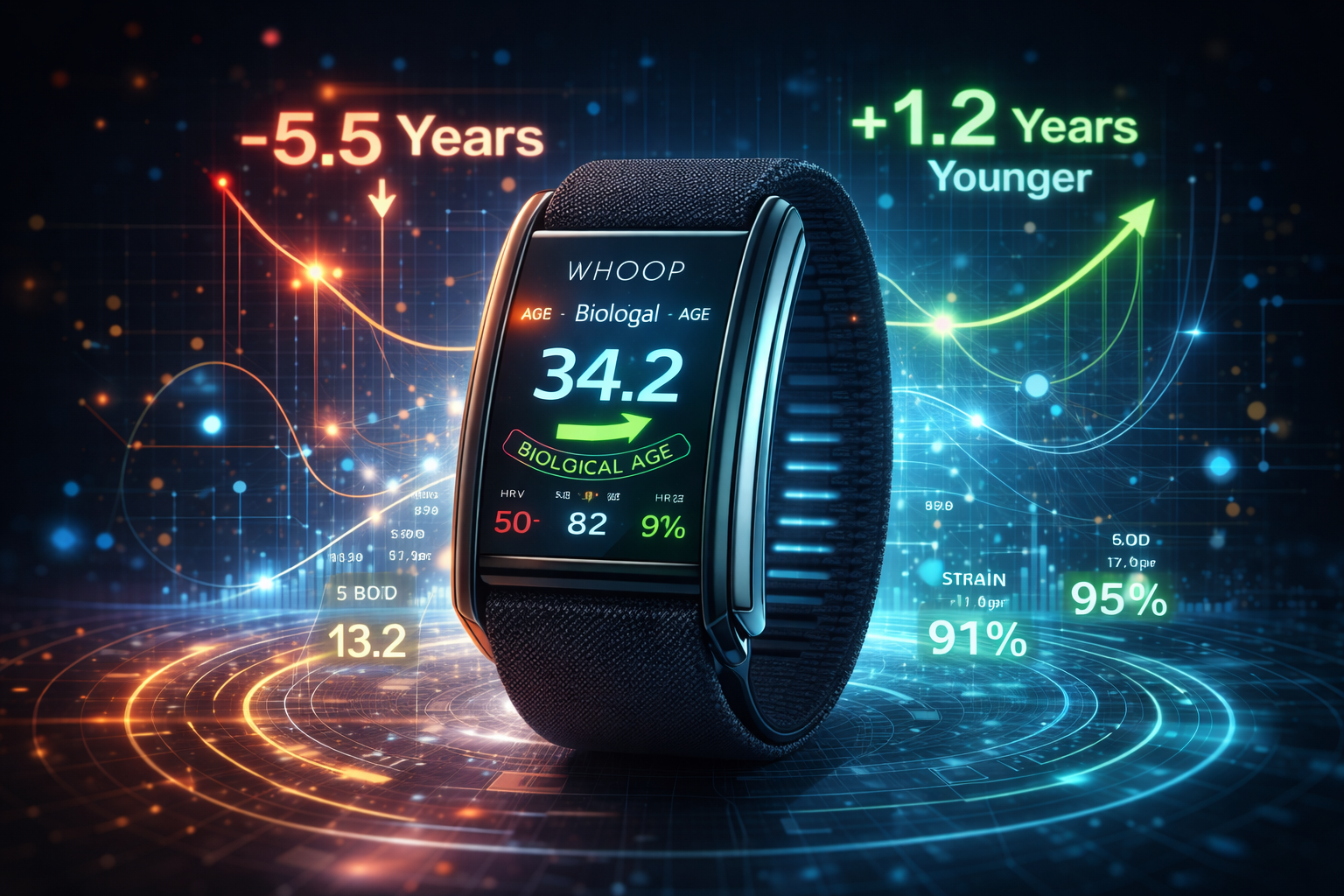
For over 500 days, I wore a wearable device continuously.
Training days. Rest days. Travel days. Bad sleep. Good sleep.
Day after day, data kept accumulating — heart rate, HRV, sleep, strain, recovery.
And for the most part, I ignored it.
Not because I don’t believe in data.
But because most personal metrics, without a decision system, are simply noise.
Then one metric appeared — and it hit harder than expected.
The Wake-Up Call I Didn’t See Coming
On May 14th, I turned 39.5, my actual birthday is November 14th 1985.
That same day, WHOOP introduced a new feature: WHOOP Age.
Out of curiosity, I checked it.
The result stopped me cold.
My biological age was calculated as 5.5 years older than my real age.
I didn’t feel old.
I trained regularly; or I thought so.
I performed at a high cognitive level every day.
But this number felt different.
Not because it was flattering or not —
but because it was a system-level signal, not a vanity metric.
And it forced a question I couldn’t ignore:
If this were an AI system in production, would I accept this output without investigation?
Why This Metric Was Different
By then, I had already seen hundreds of metrics:
- HRV
- Resting heart rate
- Sleep stages
- Recovery percentages
- Strain scores
Most of them fluctuated daily.
Most were emotionally easy to dismiss.
WHOOP Age was different.
It wasn’t a daily score.
It was a long-horizon aggregation — a proxy for cumulative system stress.
In AI terms:
- Lower volatility
- Higher signal
- Much harder to explain away
That’s exactly why it worked.
The Common Mistake With Personal Data
Most people respond to uncomfortable metrics in one of two ways:
- Panic and overcorrect
- Ignore the metric entirely
Both reactions are system failures.
In AI systems, when performance degrades, we don’t react emotionally.
We ask structured questions:
- Which inputs influence this output?
- Which variables are controllable?
- Where is the feedback loop broken?
So I treated myself like a production system.
Turning Wearable Data Into a Decision System
I didn’t try to “fix” the age metric directly.
That would be equivalent to training on the label, which is a classic modeling mistake.
Instead, I focused on upstream variables.
Step 1: Eliminate Noise
I stopped reacting to daily fluctuations.
I ignored:
- Single bad sleep nights
- One-off low recovery days
- Isolated strain spikes
I focused only on trends, not events.
This alone removed most of the emotional friction.
Step 2: Define Non-Negotiable Rules
I introduced explicit decision rules:
- Low recovery does not mean no training
It means reduced intensity, not inactivity - Consecutive high-strain days trigger enforced recovery
- Degrading sleep trends cap intensity automatically
- Increased workload requires proportional recovery investment
No motivation required.
No daily debate.
This mirrors how resilient AI systems are governed.
Step 3: Review Weekly, Not Daily
Daily optimization leads to overfitting.
So I reviewed progress weekly, not daily:
- Recovery stability
- Training consistency
- Cognitive energy
- Subjective stress levels
The question was never:
“Was today good?”
It was:
“Is the system improving?”
The Outcome (7.5 Months Later)
After 7.5 months of consistent, rule-driven behavior:
- I matched my real age
- Then surpassed it
As of today, my biological age is 1.2 years younger than my chronological age.
No hacks.
No extreme interventions.
No obsession.
Just:
- Signal selection
- Clear decision rules
- Closed feedback loops
The Deeper Lesson
This experience reinforced something I’ve seen repeatedly in enterprise AI initiatives:
Data doesn’t create change.
Systems do.
Most people don’t fail because they lack information.
They fail because they lack decision architecture.
The same pattern applies to:
- AI platforms
- Organizations
- Human performance
Why I’m Writing This Blog
In my professional work — as a senior AI and data leader — I design systems that operate under real constraints and real consequences.
This blog will explore:
- Applied AI and agentic systems
- Data-driven decision design
- Leadership lessons from production environments
- Translating engineering discipline into real life
Sometimes the system is software.
Sometimes it’s human.
The principles remain the same.
Final Thought
That number — “5.5 years older” — didn’t motivate me.
It forced me to redesign the system.
And that made all the difference.